
Holistic Wellness App • August 2026
Academic Project • AI for UX Design at Designlab
FitFuel: Designing a fitness experience that adapts when life gets in the way
FitFuel is a fictional AI-enhanced fitness app exploring a more adaptive approach to personalization. Instead of simply suggesting workouts and recommendations, I designed around a key question: “How might a fitness product respond when a user’s goals, schedule, abilities, or circumstances change?”
AI disclosure:
I used Claude throughout the project to support research synthesis, drafting, critique, and iteration within a single project space. I reviewed, challenged, and edited every output before including it in the final case study. All users, quotes, and data points are fictional or sourced from cited research. FitFuel is a fictional product created for this study.
Product Designer - research, product strategy, interaction design, prototyping
Role
Independent project with mentor feedback and peer critique
Team
Figma, Figma Make, Claude (Haiku 4.5), ChatGPT (GPT-5)
Tools
1 month. Full cycle from discovery to testing and reflection.
Timeline
01
Most fitness apps are built around consistency. Open the app. Follow the plan. Complete the workout. Keep the streak going. That model works when life is predictable. But for adults between 25 and 50, consistency can be the first thing to disappear when work gets busy, schedules change, or someone takes time away from their exercise routine. The problem I wanted to explore was simple:
What happens when a fitness app needs to meet someone where they are now - not where they were before?
I focused on three situations that often get overlooked:
The Problem
Most fitness apps are designed around consistency: follow the plan, complete the workout, etc. That model works when life cooperates. However, it often doesn’t work for adults balancing demanding jobs, travel, family, etc. The problem isn’t motivation. The plan stops fitting the person. A 45-minute workout is difficult when someone only has 10 minutes to spare between meetings.
Schedules Aren’t Stable
Coming back after a break isn’t the same as continuing a routine. Fitness level, schedules, goals, and confidence may have changed. Yet most apps resume the old plan - or treat the user like they’re starting from scratch. The opportunity: create a re-entry onboarding experience that acknowledges change and helps users rebuild without framing the break as failure.
Returning Users Need a Way Back
Many fitness experiences are built around a predictable progression: set a goal, follow the plan, improve, repeat. That leaves little room for disability, chronic conditions, injury, or days when capacity looks different. The opportunity: make flexibility part of the product - not an exception users have to walk around.
Fitness Apps Assume a Linear User
02
FitFuel’s audience doesn’t need another fitness product telling them what they should be doing. They need guidance that fits around real life. I developed the product voice around two roles: a supportive coach and a knowledgeable friend. The goal was to make AI-assisted guidance feel useful and encouraging.
Designing FitFuel’s Voice
Guide, don’t lecture.
AI should help users make decisions without telling them what they should be doing.
Simplify, don’t overwhelm.
Re-entry should feel manageable. The product should reduce decisions rather than introduce another complicated plan.
Encourage progress, not perfection.
Progress metrics should reinforce what users are accomplishing rather than draw attention to what they didn’t do.
Respect capacity.
The product should account for a user’s available time, energy, and ability on any given day.
🔊 Voice Principles
I intentionally moved away from language that frames missed workouts as failure - words like weak, punishment, or you missed X days.
Instead, FitFuel uses language centered on progress, capability, flexibility, and movement.
The result is a voice that treats adaptation as a feature of the experience, not a failure to follow the plan.
Language in Practice
03
Understanding the User
Generate seven user personas, including three core archetypes for FitFuel, an AI-enhanced fitness app tailored to busy professionals. Individuals should be aged 25-50 with varying fitness levels. Personas should span a variety of ages, genders, and medical backgrounds.
Core Questions:
What does “progress” mean for returning users? (strength, consistency, form, or something else?)
How do users want the app to adapt? (easier/harder workouts, different movements, shorter sessions?)
Do users want the app to adapt or do individuals want the app to notice and suggest it?
Prompt Claude:

Alex, 32, Marketing Manager
Alex wants to become stronger and improve her overall health, but her schedule is unpredictable. She doesn’t need motivation; she needs workouts that can fit into the 10-15 minutes he actually has.
Need: Flexibility without having to rebuild a plan every week.
“I have not failed at fitness because I’m bad at planning. I’ve failed at fitness because my life is unpredictable.”
Time-Constrained Parent

Caleb, 41, Operations Manager
Caleb has exercised consistently in the past but is trying to rebuild his routine after time away. He wants to regain strength and manage stress without turning fitness into another obligation.
Need: A low-friction way to understand where he is now and ease back in.
“I’m not lazy. I’m just tired. There’s a difference.”
Returning Routine Builder

Edgar, 50, Retired
Edgar wants to stay active without overexertion. Traditional fitness experiences can feel overwhelming when they assume a particular level of ability, intensity, or motivation.
Need: A routine that can adjust to changing capacity.
“A good and a bad day are both real.”
Edge-Case Access Needs
04
AI Framework
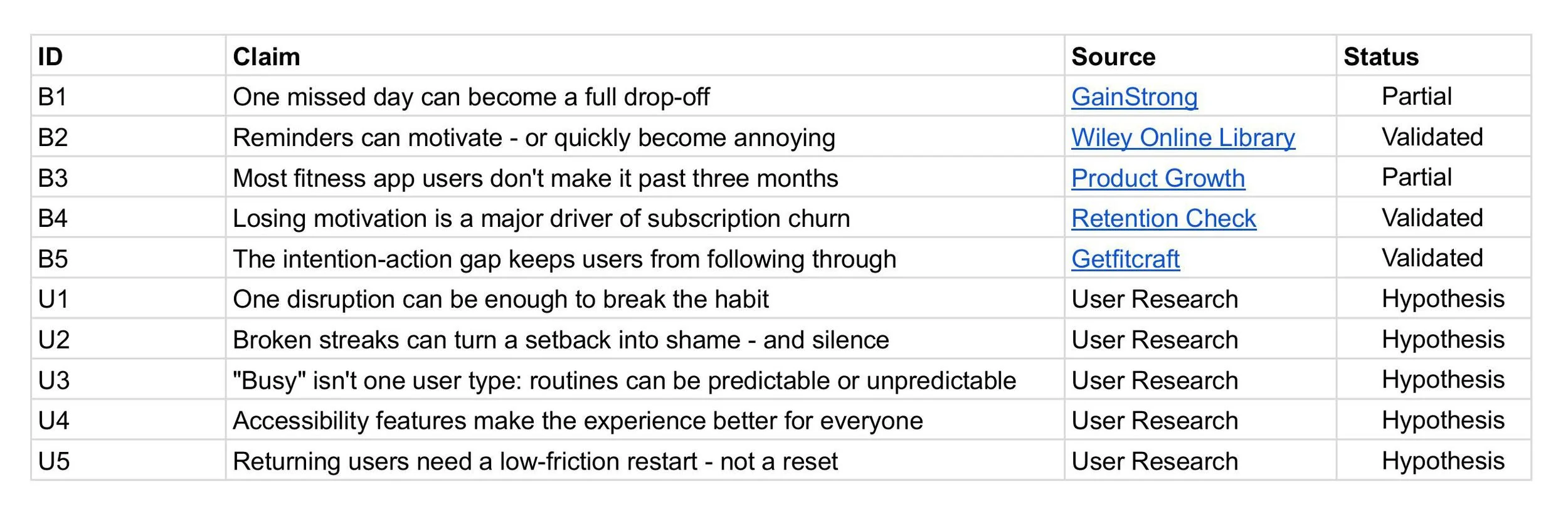
Evidence Labeling
Every claim was labeled as Validated, Partially Validated, Hypothesis, or Assumption, with a clear link back to the interview, study or source that supported the claim.
Inclusion Review
Every persona and user journey map was reviewed for default assumptions regarding age, body type, ability, and culture.
Accessibility Audit
All screens were reviewed against WCAG 2.2. AA using both an automated checker (OnBeacon) and a manual screen-by-screen audit. Automation caught technical issues; the manual review uncovered interaction patterns that automation missed.
AI Verification
Claude handled the first draft of research synthesis, but every finding was verified before it became part of the design.
Ethics & Bias Audit Process
Diversity Gaps
30% of user persona output contained related occupations. 80% was in an occupation that could be similar to the 30%.
5/7 of the personas ages are 32-46, too close in age
4/7 of the personas have high/expert fitness backgrounds (former competitive athletes), whereas 3/7 of the personas have moderate fitness backgrounds or are returning after an injury.
Biases found and corrected
Set Milestones
Pause at each strategic points to run through the bias checklist
Check for bias with each LLM or image generation
Review work with stakeholders
Conduct a final bias audit before publishing
Moving Forward
05
Claude Prompt: Research what adults aged 25-50 actually do when their fitness routine gets disrupted, rather than what they say they do. Identify behavioral patterns documented in user research, app store reviews, social discussions, and industry studies. Focus on how people respond to missed workouts, changing schedules, returning after a break, and fitness plans that no longer fit their circumstances.
User Behavorial Patterns
Assumed Preferences
Users want personalized suggestions on workouts due to medical history
Users want to use a fitness app that is encouraging, supportive, and feels like a encouraging friend rather than a nagging coach
Convenience and personalization that fits into their busy schedule
People want apps that acknowledge their break and doesn’t shame them
Opportunities to Validate
Do users want automated metrics tracking or do they want some level of manual input such as X sessions completed since re-entry, X movement days, etc?
Do users really want personalized workouts or do they want better tracking and analytics?
Research shows that users want an encouraging, motivating tone, but are we excluding users who thrive on structure?
AI coaching, shame-free motivation, and adaptable inclusivity
06
Prompt Claude
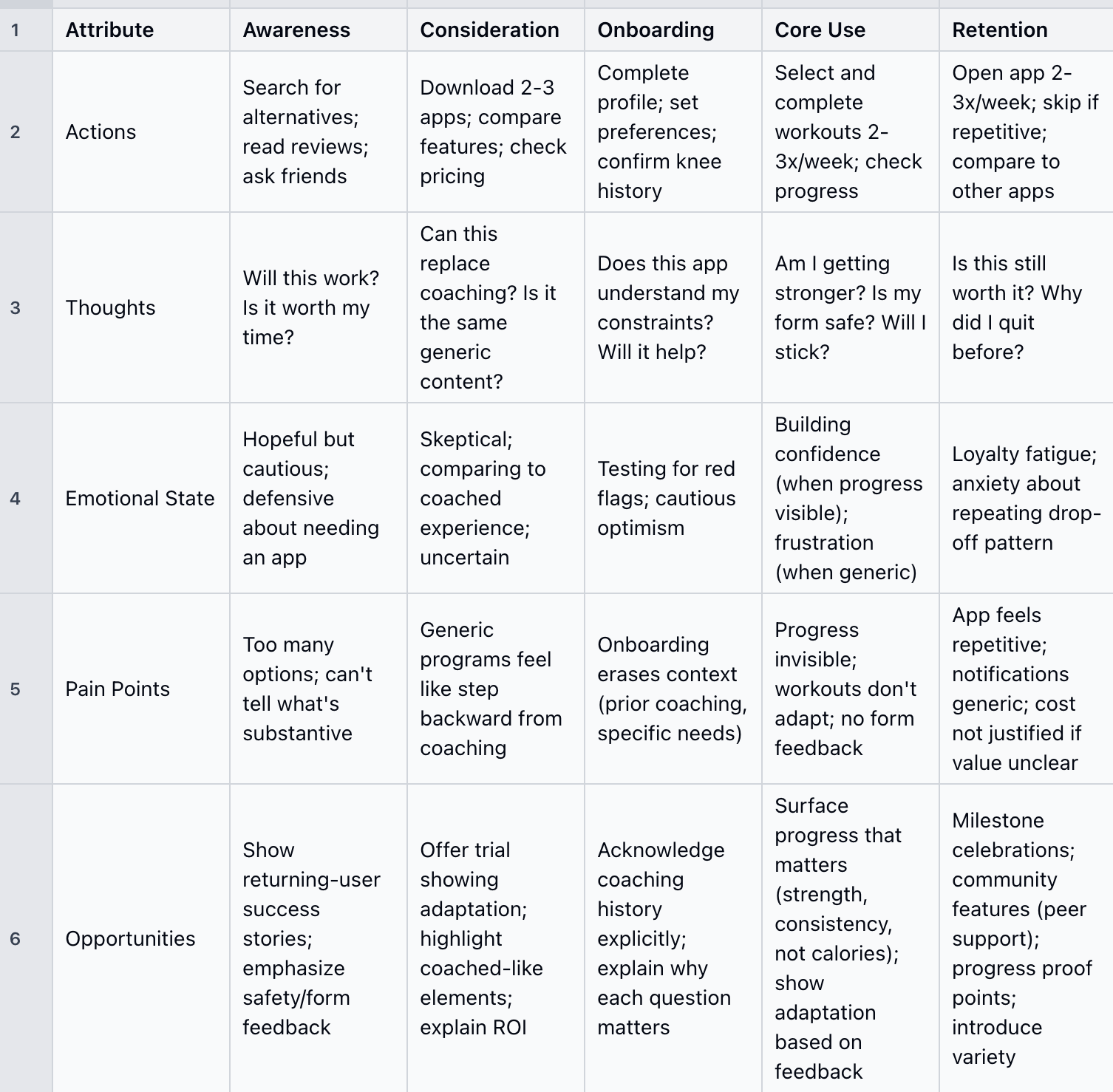
Create a user journey map for our primary persona, Alex, who is adapting to FitFuel.
Map his experience across these five stages:
Awareness - How did he first learn about the product?
Consideration - What makes him decide to try FitFuel?
Onboarding - What are his thoughts during this process?
Core Use - What does a typical week look like for him?
Retention - What keeps him from coming back?
For each stage, describe:
Specific actions he takes
What he is thinking about
Emotional state and pain points
Opportunities for AI-assisted tools to help
User Journey Map
07
AI-Enhanced Rapid Prototyping Process
Prompt Figma Make:
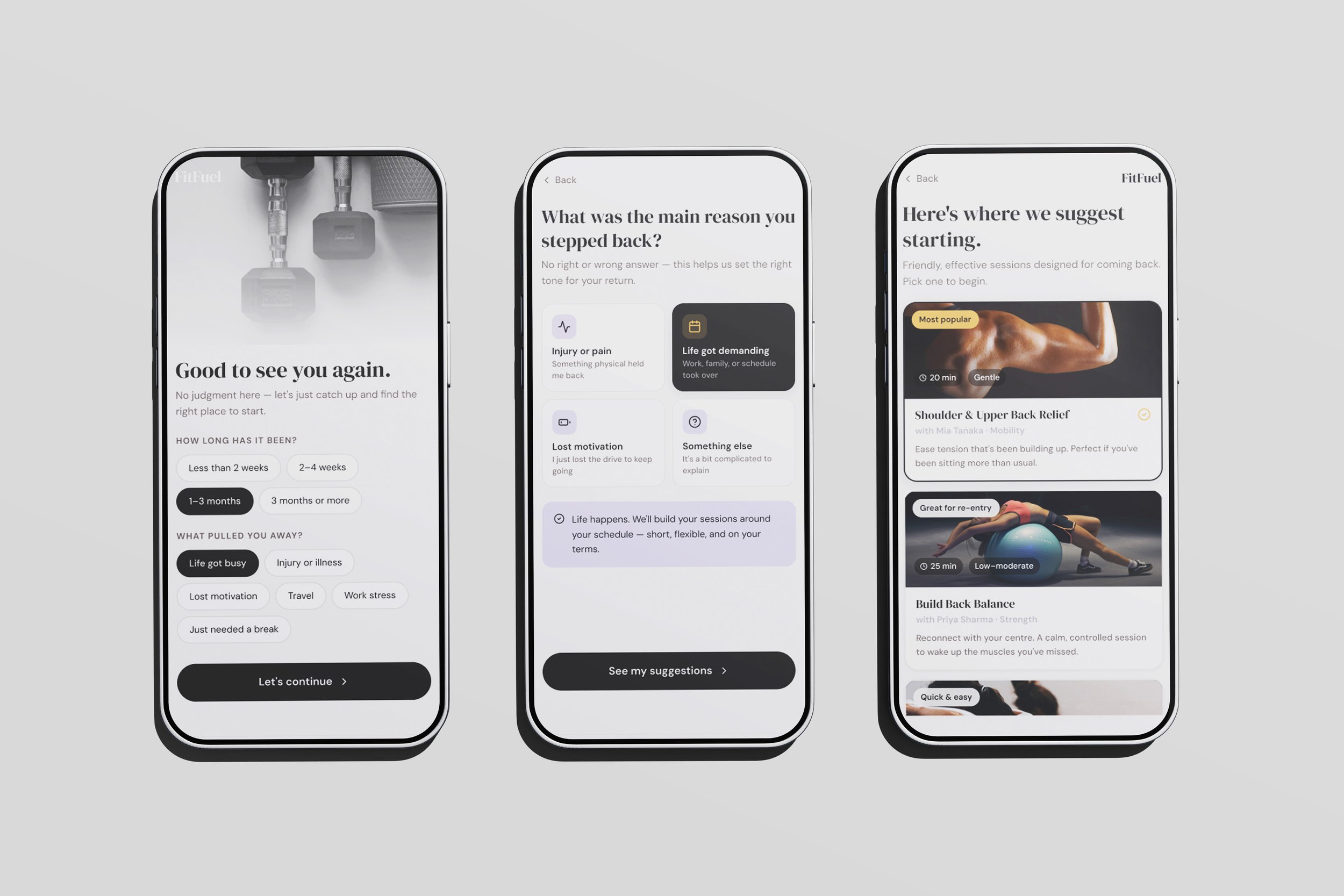
Design a high-fidelity five-screen mobile onboarding experience for FitFuel, a modern fitness app for busy professionals and people returning to fitness. The experience should feel warm, calm, friendly, and visually engaging, providing clear, simple guidance without overwhelming users aged 25–50.
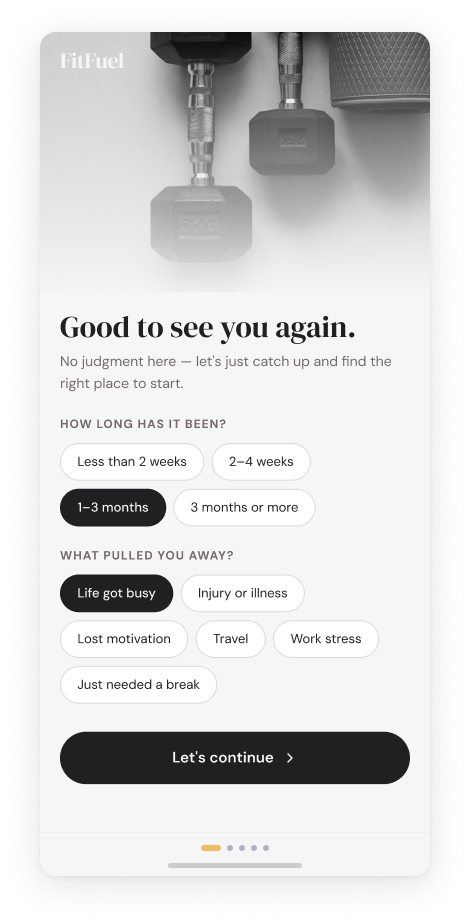
Screen 1 (Gap Acknowledgement):
Goal: Meet users where they are today. Returning users expect the app to remember them and adjust.
Inputs captured: “When did you last use FitFuel?”
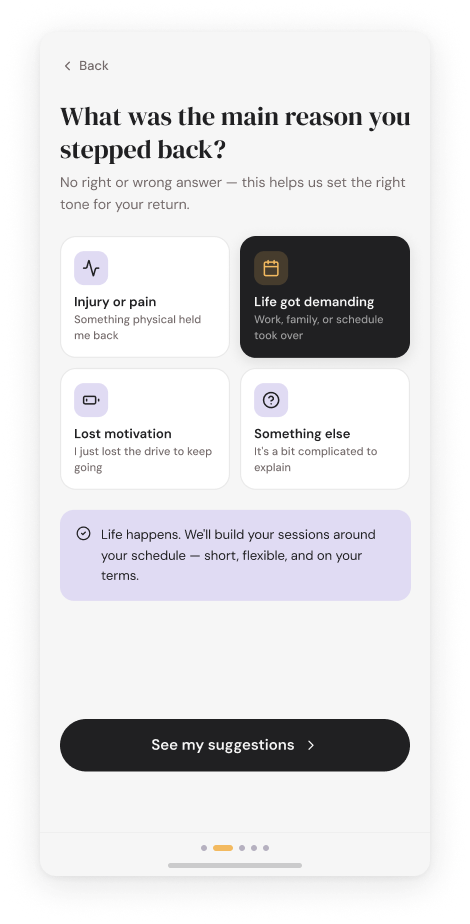
Screen 2 (Re-entry Baseline):
Goal: Capture how the break has affected their capacity. No “What’s your fitness level now?” but “What was the main reason you stepped back?”
Inputs captured: “Are there any injuries or physical changes since you stopped?”
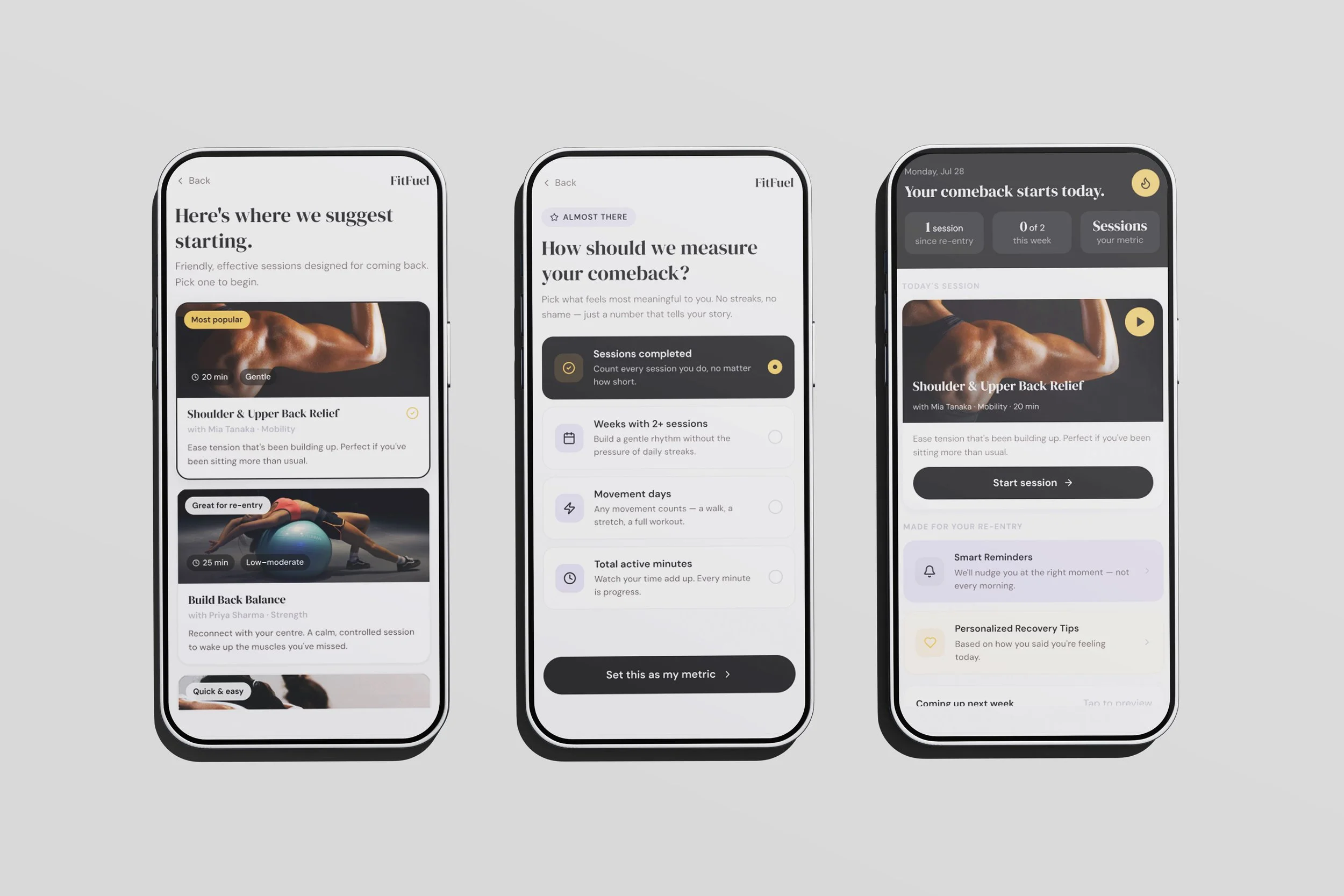
08
Final Prototype
09
Key Takeaways
During this project, I learned not to trust my initial framing. The “obvious” problem you start with is often a symptom, not the root. Talk to people early, and be willing to throw away a design direction if the data says so.
Research can flip your product direction
Labeling everything as Validated, Hypothesis, or Assumption felt overly academic at first - like I was admitting I didn’t have all the answers. But the opposite happened. Once I separated what I actually knew from what I was guessing, I could argue harder for the guesses that mattered.
Ambiguity is information
User streaks adapted in fitness apps cause churn. The research was clear. But I didn’t solve it - I flagged it. Although this can feel like incomplete work, I realized that naming an unsolved problem in a case study is actually harder than shipping a half-baked fix.
Unfinished problems can haunt you